


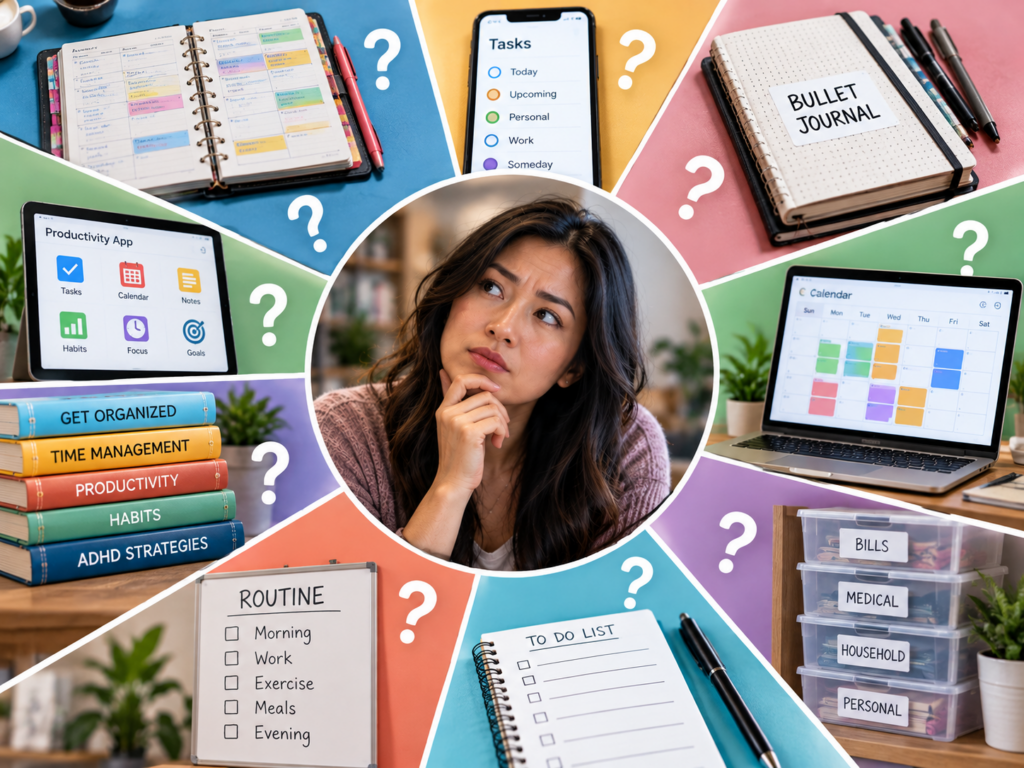
You have finally found it: the planner, app, notebook, filing system, morning routine, or productivity method that is going to change everything. You spend an evening setting it up, perhaps buying some new pens or creating color-coded categories, and for the next several days you feel more organized than you have in years. Appointments are remembered, tasks are captured, and you wonder why nobody told you about this system before.
Then something happens. You miss a day. The planner stays closed. Notifications become background noise. The carefully designed categories start requiring more work than they save, and three weeks later your revolutionary new system has joined all the others in what might be called the ADHD Productivity Graveyard.
Naturally, you conclude that you need a better system.
Why New Systems Feel So Good
There is a reason the beginning can be exhilarating. ADHD involves differences in brain systems associated with attention, reward, motivation, working memory, inhibition, and executive control, and novelty can be particularly effective at capturing attention. A new organizational system isn’t boring yet. It is a project to explore, customize, and master, with frequent little rewards as you set it up and imagine the more organized person you are about to become.
Dopamine is part of this process, although ADHD is much more complicated than the popular shorthand of simply having “too little dopamine.” Dopamine participates in motivation, reward learning, and determining which possibilities deserve attention. A new system offers novelty and immediate feedback, while maintaining the same system six weeks later offers considerably less of either.
The very tool designed to manage routine has become routine.
A System Has to Be Remembered Before It Can Help You
There is another problem hidden inside organizational systems: they require executive function to operate.
You have to remember to open the planner, enter the appointment, check the calendar, update the task, put the object in its designated place, review tomorrow’s schedule, and return to the system after an interruption. Working memory helps keep these intentions active, while prospective memory helps you remember to carry them out later.
Research continues to find difficulties with organization in time and everyday prospective memory among adults with ADHD. In other words, a system can contain exactly the information you need and still fail if your brain doesn’t reliably prompt you to consult it at the right moment.
This creates an ADHD paradox: you build an organizational system to compensate for executive-function difficulties, but then the system itself begins demanding executive function.
The Perfect System Is Usually Too Perfect
Many systems also fail because we design them for our best days. Every task gets categorized, every hour scheduled, every project assigned a color, and every morning begins with a 20-minute planning ritual.
That may work beautifully when you are rested and enthusiastic. Then comes a bad night’s sleep, an unexpected deadline, a sick child, travel, or simply a chaotic Tuesday, and suddenly the system requires more effort than you have available.
Once you fall behind, catching up becomes another task. For some people, perfectionism then turns one missed day into abandonment: I’ve already messed up the system, so I’ll start again Monday.
The solution may be surprisingly counterintuitive. Instead of finding a more sophisticated system, build a smaller one.
Reduce the Number of Moving Parts
An ADHD-friendly organizational system should require as little remembering and maintenance as possible. One calendar that you actually check is more useful than three beautifully synchronized calendars that you don’t. A simple task list may outperform an elaborate productivity platform if it remains visible and easy to use.
Make the system hard to overlook. Keep the planner open on your desk. Put tomorrow’s three priorities where you will see them. Use calendar alerts for appointments rather than expecting yourself to remember to check the calendar. Attach a new routine to something that already happens reliably, such as reviewing your day while drinking your morning coffee.
Most importantly, design for recovery. Missing Tuesday should not destroy Wednesday. A useful system allows you to disappear for three days and return without spending an hour reconstructing what happened.
Change the System Without Abandoning It
Novelty doesn’t have to be the enemy. If your brain responds to change, build controlled change into a stable framework. Use different locations for a weekly planning session, occasionally change the visual layout, or turn a tedious review into a short challenge. Keep the underlying structure while refreshing the experience.
This distinction matters because endlessly replacing systems means repeatedly rebuilding infrastructure. Refreshing a simple existing system can provide novelty without forcing you to start over.
When Another Person Becomes Part of the System
Executive function coaching can be especially useful here because a coach can help you stop asking, “Which system should I use?” and begin asking, “Where does my system actually break?”
Perhaps you don’t capture tasks reliably. Perhaps you capture everything but never review it. Maybe you overestimate what fits into a day, forget appointments unless reminded, or abandon routines as soon as the novelty disappears. A coach can help identify those patterns, simplify the system, create accountability, and adjust it as circumstances change.
The goal isn’t to make you dependent on another person or to impose somebody else’s organizational method. It is to discover what combination of external structure, reminders, routines, accountability, flexibility, and stimulation allows your brain to function more reliably.
Good Enough May Be the Perfect System
There probably isn’t a planner, app, notebook, or productivity philosophy that will finally make organization effortless. In fact, searching for the perfect system can become its own particularly appealing form of procrastination, because designing a new productivity system is often much more stimulating than doing the work the system is supposed to organize.
The best system may therefore be the one that feels almost disappointingly simple. It remembers things you might forget, makes priorities visible, requires very little maintenance, survives interruptions, and allows you to come back after you wander away.
The perfect system isn’t the one you never abandon. It’s the one that makes it easy to return.
Learn More
- https://add.org/adhd-planner/
- https://www.additudemag.com/how-to-stick-to-a-routine-adhd/
- https://www.urmc.rochester.edu/MediaLibraries/URMCMedia/childrens-hospital/developmental-disabilities/ndbp-site/documents/73-ADHD-Friendly-Ways-to-Organize-Your-Life.pdf
- https://adhdvancouver.ca/creating-new-habits-with-adhd-simple-tips-that-actually-work/
- https://pmc.ncbi.nlm.nih.gov/articles/PMC13295911/