

The Child Who Does Not Quite Fit
Imagine a bright ten-year-old sitting in a classroom. He understands the lesson almost immediately, but twenty minutes later he is staring out the window. His desk is disorganized. He forgets to turn in work he has already completed. He interrupts when an idea suddenly occurs to him, and when the class is asked to follow a familiar procedure, he wants to know why they cannot try something different.
In an achievement-oriented educational culture, it’s easy to construct a story about this child. He needs to be more disciplined. He needs to concentrate. He needs to become more organized and learn to follow directions.
Some of that may be true. Children with ADHD need help developing the executive function skills that allow ideas and intentions to become accomplishments. But there is another question we should be asking: What if some of the characteristics making this child difficult to educate conventionally are related to capacities that society will desperately need from him later?
Perhaps he sees possibilities other people overlook. Perhaps novelty energizes him. Maybe his mind makes connections between seemingly unrelated ideas. Or he is unusually willing to experiment, question assumptions, or become intensely absorbed in something that genuinely interests him. The challenge is not to romanticize ADHD. It is to recognize that human differences rarely divide neatly into strengths and weaknesses. Much depends on context.
What Neuroscience Tells Us About the Creative ADHD Mind
ADHD is fundamentally associated with differences in the regulation of attention, motivation, inhibition, working memory, and other executive functions. These differences can create substantial challenges in school, relationships, and employment.
Yet attention in ADHD is not simply absent. It’s often highly dependent on context. Routine tasks with distant rewards can be extraordinarily difficult to sustain, while work involving novelty, urgency, personal meaning, challenge, or intense interest can sometimes command remarkable attention. Many people with ADHD describe periods of deep absorption—often called hyperfocus—when something captures their interest.
Research also offers intriguing evidence connecting ADHD characteristics with divergent thinking, the ability to generate numerous and unconventional possibilities from a problem. Studies have found associations between ADHD symptoms and measures of fluency, flexibility, and originality in idea generation.
That does not mean everyone with ADHD is unusually creative, nor does it mean ADHD automatically produces creativity. Creativity is far more complex than any diagnosis. But it does suggest that some cognitive characteristics associated with ADHD may be advantageous when the task is not to reproduce the expected answer but to imagine one that does not yet exist.
And that distinction matters enormously in a rapidly changing and uncertain world.
Why Entrepreneurship Can Feel Different
Traditional organizations often reward consistency, predictability, procedural compliance, and sustained attention to tasks that someone else has decided are important. Entrepreneurship frequently demands something different.
Entrepreneurs notice unmet needs. They connect ideas. They tolerate uncertainty. They experiment. They persuade others to believe in something that does not yet exist. They change direction when evidence suggests the original plan is wrong. Entrepreneurship is, in many respects, creative work.
For some people with ADHD, that environment can be liberating. Instead of trying to maintain attention on work that feels disconnected from their interests, they can build work around problems that genuinely engage them. Instead of being penalized for questioning the established procedure, questioning the established procedure may be precisely why customers need them.
The same may be true in many other careers. Design, technology, filmmaking, emergency medicine, journalism, marketing, sales, skilled trades, product development, consulting, the arts, and other fields can reward curiosity, responsiveness, improvisation, intense engagement, or creative problem-solving. The important question may therefore be less, “What are the best careers for ADHD?” than “What kind of environment allows this particular person’s mind to do its best work?”
The Problem With Achievement Culture
Unfortunately, many children receive a very different message. Achievement culture tends to reward a relatively narrow set of abilities early in life: sitting still, remembering instructions, completing assignments on schedule, organizing materials, tolerating repetition, and producing predictable results. These are valuable skills. But they are not the only abilities that matter in adulthood.
A child can therefore spend years being evaluated primarily in areas where their brain struggles while receiving surprisingly little recognition for imagination, curiosity, initiative, storytelling, mechanical intuition, leadership, humor, pattern recognition, or the ability to see possibilities others miss. Over time, repeated correction can shape identity. The child does not conclude, “My executive functions are developing differently.” The child concludes, “I’m not very good at things.”
That may be one of the greatest lost opportunities associated with ADHD. Education should certainly help children strengthen areas that are difficult for them. But education should also help them discover the places where they come alive.
Imagine what might change if an ADHD child heard both messages: “We are going to help you learn to plan, organize, and follow through.” And: “We are also going to pay attention to what fascinates you, what you’re unusually good at, and what kind of contribution you might someday make.”
That’s a very different developmental story.
A Post-Industrial World May Need These Minds
There is an interesting historical irony here. For much of the industrial era, economic success depended heavily on standardization. Schools and workplaces were organized around schedules, procedures, repetition, hierarchy, and predictable outputs. We are now moving rapidly into something different. Artificial intelligence and automation are increasingly capable of performing routine cognitive tasks that once required human labor. Meanwhile, employers are placing greater value on creative thinking, adaptability, resilience, technological literacy, and the ability to solve unfamiliar problems.
The World Economic Forum’s Future of Jobs Report 2025 identifies creative thinking, resilience, flexibility, agility, curiosity, and lifelong learning among the skills rising in importance. Those are striking priorities.
The economy that sometimes punished the restless, curious student may increasingly need adults who can question assumptions, move between ideas, tolerate ambiguity, learn rapidly, and imagine alternatives. This does not mean the future “belongs to ADHD.” It does mean that our definition of valuable human capability is broadening. And perhaps our educational systems should broaden with it.
Strengths Still Need Structure
There is an important caution. A brilliant idea that is never completed remains an idea. An entrepreneur who constantly starts businesses but cannot manage money, deadlines, employees, or commitments will eventually encounter serious problems. A creative professional who generates extraordinary concepts but repeatedly misses deadlines may struggle to sustain a career.
This is where the strengths-based conversation about ADHD sometimes goes wrong. Celebrating creativity without addressing executive function does people with ADHD no favors. The goal is not to choose between strengths and support. It is to combine them.
Executive Function Coaching as a Bridge
Executive function coaching can play an especially valuable role because it does not ask the individual to become a different kind of thinker. Instead, coaching can help build structures around the mind they already have. A young person may learn to turn a large goal into smaller steps, externalize deadlines, estimate time more realistically, recognize when attention is drifting, create accountability, and develop routines that protect rather than suppress creativity.
Eventually, these skills become more than strategies for getting through school. They become entrepreneurial skills. Knowing how to convert a vision into a plan, decide what matters most, manage competing priorities, recover from setbacks, and recognize when help is needed can determine whether creativity remains potential or becomes accomplishment.
Coaching can therefore provide a bridge between the capacity to imagine and the capacity to execute.
Give the Mind Power Tools
There is another part of this story that is changing rapidly: technology. For generations, people with executive function challenges had to compensate largely through effort. Today, they have access to what we might think of as cognitive power tools.
Digital calendars can externalize time. Automated reminders can support prospective memory. Project-management systems can make invisible tasks visible. Voice-to-text can capture ideas before they disappear. AI can help organize scattered thoughts, break projects into steps, summarize information, create first drafts, develop schedules, and provide prompts when someone becomes stuck. For a creative person with ADHD, these tools can be transformative.
A carpenter is not considered less skilled because a power saw allows work to be completed more efficiently than a hand saw. In the same way, using technology to support executive function does not diminish human ability. It can free the individual to devote more cognitive energy to the work humans do best. The important question becomes not, “Can you do this without help?” but “What combination of human strengths, learned skills, supportive relationships, and tools allows you to do your best work?”
From Fixing Weaknesses to Developing Potential
Perhaps this is where parents and educators have the greatest opportunity. A child with ADHD certainly needs help learning to navigate a world that will still contain deadlines, obligations, routines, and tasks that are not particularly interesting. We should not pretend otherwise. But childhood should not become a fifteen-year remediation project. We should also be watching for sparks.
- What does this child investigate without being asked?
- What kinds of problems capture their attention?
- When do they become animated?
- What do they create?
- What unusual connections do they make?
- Where does persistence suddenly appear when everyone has been told they “cannot focus”?
Those clues may point toward more than hobbies. They may reveal the beginnings of a future identity. A teenager who spends hours creating videos may someday work in digital media. The student endlessly modifying a computer may become a software entrepreneur. The child who questions every rule may someday redesign a system everyone else assumed could not be changed.
We cannot know where these interests will lead. Our responsibility is to make sure they survive long enough to find out.
The Minds We Need Next
For much of modern history, society has asked neurodivergent people to adapt themselves to institutions designed around a relatively narrow definition of normal performance. The coming decades may require a more reciprocal relationship.
People with ADHD will still need to develop executive function, emotional regulation, reliability, and the ability to collaborate with others. But schools, workplaces, and communities may also need to become better at recognizing cognitive differences as potential sources of innovation. Because the problems ahead of us are unlikely to be solved simply by doing yesterday’s work more efficiently.
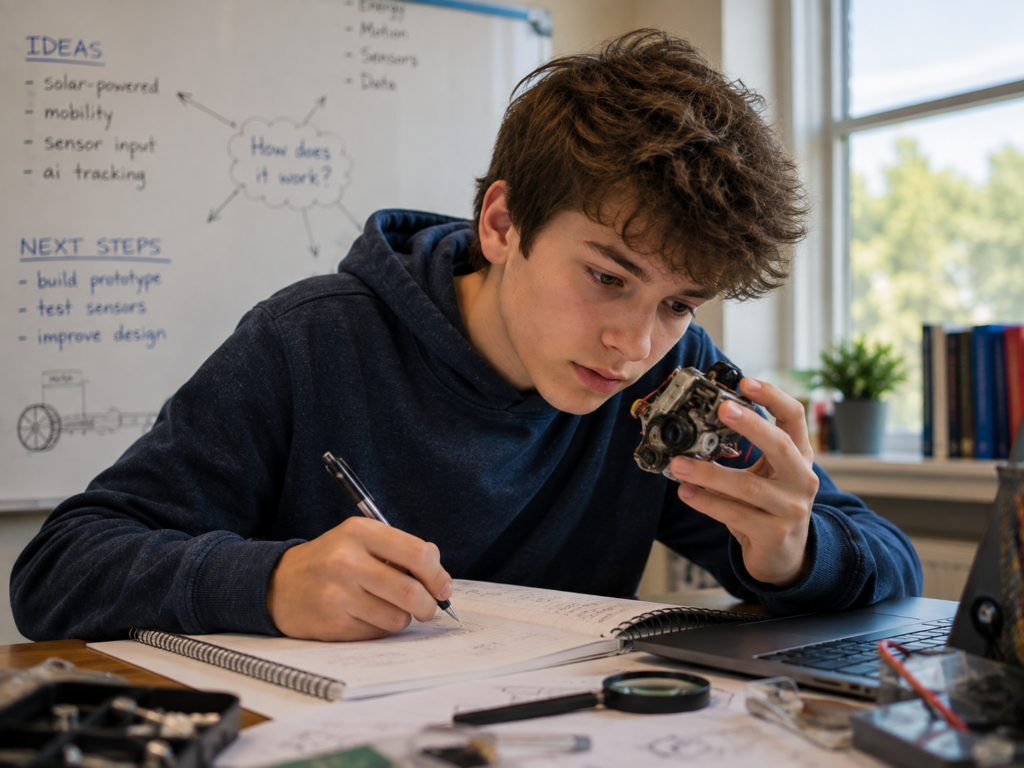
Climate adaptation, artificial intelligence, healthcare transformation, new forms of education, changing communities, and entirely new industries will require people willing to explore what does not yet exist. Some of those people are sitting in classrooms today, staring out windows, doodling in notebooks, taking things apart, starting projects they have not quite figured out how to finish, and asking questions their teachers did not expect.
They need guidance, executive function skills. coaching, encouragement, and increasingly sophisticated power tools. But they also need something more fundamental. They need adults who can look beyond the difficulties of today and recognize the possibilities of tomorrow.
If we can provide both—support for the challenges and room for the strengths to grow—we may discover that some of the young people who have the hardest time fitting into an achievement culture are precisely the people capable of helping us imagine what comes after it.
Learn More
- https://www.psychologytoday.com/us/blog/leadership-diversity-and-wellness/202510/why-traditional-productivity-advice-fails-adhd/amp
- https://www.frontiersin.org/journals/psychiatry/articles/10.3389/fpsyt.2022.909202/full
- https://www.understood.org/en/articles/adhd-ai-tools
- https://www.additudemag.com/entrepreneurship-adhd-business-research-traits-stories
- https://www.weforum.org/stories/2025/01/future-of-jobs-report-2025-whats-shaping-the-future-of-the-global-workforce
- https://ectutoring.com/adhd-and-entrepreneurship/