


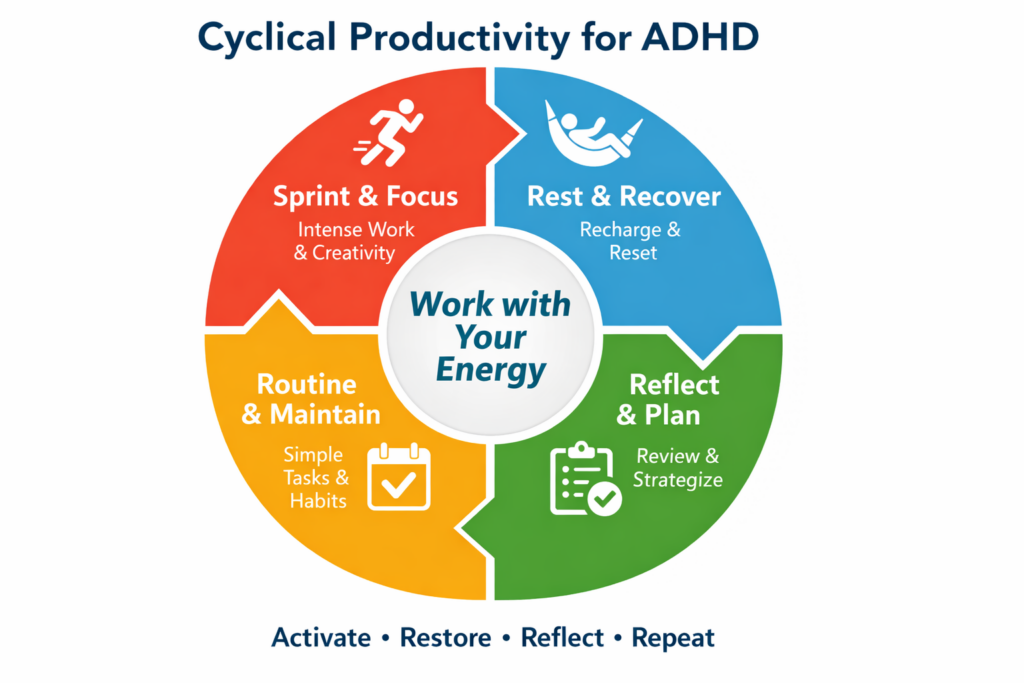
If you live with ADHD, you’ve probably spent years trying to become more consistent. You’ve tried daily routines, rigid schedules, productivity systems, and motivational strategies that promise steady output. Yet despite your best efforts, your focus and energy seem to rise and fall unpredictably. What often gets overlooked is that ADHD productivity is rarely linear. Instead, it follows rhythms — natural cycles of activation, engagement, fatigue, and recovery.
Traditional productivity culture assumes that performance should be stable from day to day. This expectation works reasonably well for some nervous systems, but it often creates frustration and shame for adults with ADHD. When you measure yourself against a standard of constant discipline, you may interpret natural fluctuations as personal failure. In reality, your brain is responding to shifts in stimulation, emotional load, sleep quality, novelty, and stress chemistry. Productivity becomes more sustainable when you design systems that respect these changing states rather than fight them.
Understanding Activation Windows
Many ADHD adults experience what can be called “activation windows.” During these periods, motivation, clarity, and creative energy surge. You may complete complex tasks quickly, generate new ideas, and feel unusually confident in your abilities. The problem arises when you expect this level of performance to continue indefinitely. Without recognizing the need for recovery, you may overextend yourself, leading to sudden drops in focus, irritability, or avoidance. Cyclical productivity models help you use these activation windows strategically while planning for the inevitable downshifts.
Recovery Is Part of Productivity
Recovery is not the opposite of productivity — it is part of it. Your nervous system needs deliberate opportunities to reset after periods of intense cognitive effort. This may include movement, social connection, time outdoors, creative play, or simply stepping away from demanding tasks. When recovery is planned rather than accidental, you reduce the risk of burnout and emotional overwhelm. Over time, this creates more predictable rhythms of engagement and restoration.
A cyclical approach also shifts the focus from time management to energy management. Instead of asking, “What should I get done today?” you begin to ask, “What state is my brain in right now?” This subtle change can transform how you prioritize tasks. High-demand work becomes aligned with periods of peak activation, while administrative or routine activities are reserved for lower-energy phases. You start working with your nervous system rather than trying to dominate it.
Weekly and monthly rhythms can be just as important as daily cycles. Many adults with ADHD function best when their schedules include intentional variation — for example, sprint days devoted to deep work followed by lighter days for planning, communication, or learning. Seasonal patterns may also influence your productivity. Recognizing these longer cycles allows you to anticipate fluctuations instead of being surprised by them.
Finally, cyclical productivity supports a more compassionate relationship with yourself. When you understand that variability is a feature of ADHD rather than a flaw, you can replace self-criticism with curiosity. You begin to track patterns, experiment with structure, and design environments that stabilize focus over time. Productivity becomes less about forcing consistency and more about cultivating rhythm. In that rhythm, many adults with ADHD discover not only improved performance, but also greater resilience and satisfaction in their work and lives.
References
- https://www.psychologytoday.com/us/blog/promoting-empathy-with-your-teen/202503/adhd-productivity-trap-stop-being-busy-start-doing
- https://add.org/adhd-burnout/
- https://www.brain.fm/blog/adhd-productivity-evidence-based-strategies
- https://www.coachingexecutivefunction.com/post/adhd-friendly-work-habits-that-are-revolutionizing-focus-and-flow
- https://www.adhdweasel.com/p/adhd-burnout-work-cycles