


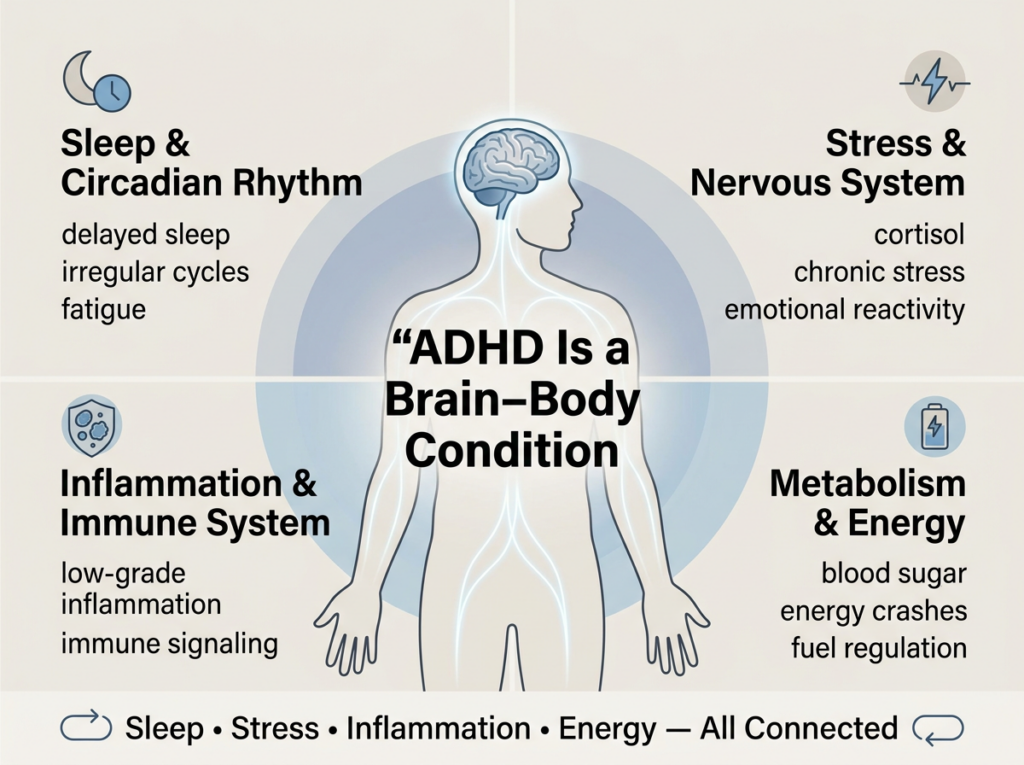
For years, ADHD has been understood primarily as a disorder of attention, focus, and behavior. But a growing body of research suggests something more complex: ADHD is also deeply connected to the body. Many adults with ADHD experience chronic fatigue, sleep disruption, digestive issues, and fluctuating energy levels. These are often treated as separate problems, when in reality they may be part of the same underlying system — one shaped by stress chemistry, inflammation, and metabolic regulation.
The Nervous System Is Always Involved
At its core, ADHD is a condition of nervous-system regulation. This doesn’t just affect attention — it influences how your body responds to stress. Many adults with ADHD spend years in a heightened state of activation, driven by urgency, pressure, or the need to “catch up.” Over time, this can dysregulate cortisol patterns, disrupt sleep, and reduce the body’s ability to recover.
When your nervous system is persistently strained, your body begins to compensate. You may rely more heavily on caffeine, sugar, or bursts of adrenaline to function. These short-term solutions can further destabilize energy and contribute to longer-term metabolic strain.
Inflammation and the ADHD Connection
Emerging research suggests that inflammation may play a role in ADHD symptoms for some individuals. Low-grade, chronic inflammation can affect brain function, including neurotransmitter activity and cognitive clarity. At the same time, lifestyle factors common in ADHD — irregular sleep, inconsistent eating patterns, and high stress — can increase inflammatory load.
This creates a feedback loop. Cognitive challenges make it harder to maintain consistent health habits, while physiological stress makes it harder to focus, regulate emotions, and sustain effort. Breaking this loop often requires addressing both brain and body together.
Sleep, Energy, and the Crash Cycle
Sleep disruption is one of the most common — and underappreciated — aspects of adult ADHD. Difficulty winding down, inconsistent sleep schedules, and delayed circadian rhythms can all interfere with restorative sleep. The result is a cycle of daytime fatigue, reduced executive function, and increased reliance on stimulation to stay alert.
You may notice periods of intense productivity followed by sharp energy crashes. These fluctuations are not simply motivational — they are physiological. Blood sugar variability, sleep debt, and stress hormones all contribute to these patterns. Stabilizing energy often begins with stabilizing rhythms.
The Gut-Brain and Metabolic Connection
There is increasing interest in how gut health and metabolism influence cognitive function. The gut-brain axis — the bidirectional communication between your digestive system and your brain — plays a role in mood, attention, and inflammation. Irregular eating patterns, common in ADHD, can disrupt this system and contribute to energy instability.
In addition, some adults with ADHD may be more vulnerable to metabolic challenges, including insulin resistance or weight fluctuations. While these issues are complex and multifactorial, they highlight the importance of viewing ADHD through a whole-body lens.
A More Integrated Approach to Care
What does this mean for you? It suggests that improving ADHD symptoms may not come solely from cognitive or behavioral strategies. Supporting physical health — through sleep consistency, regular nourishment, movement, and stress reduction — can directly influence focus, mood, and resilience.
This is not about perfection or rigid routines. It is about creating supportive conditions for your nervous system. Small shifts — eating more regularly, getting morning light exposure, incorporating movement into your day — can have outsized effects over time.
From Fragmentation to Integration
When you begin to see ADHD as both a brain and body condition, something important shifts. Instead of chasing productivity in isolation, you start building stability from the ground up. Energy becomes more predictable. Emotional reactivity softens. Focus becomes less of a battle.
The goal is not to eliminate variability, but to reduce the extremes. In doing so, you move from a pattern of spikes and crashes toward a more sustainable rhythm — one that supports both your cognitive performance and your overall health.
References
- https://www.nature.com/articles/s41398-023-02729-3
- https://www.mdpi.com/1422-0067/26/16/7967
- https://www.additudemag.com/physical-health-conditions-adult-adhd-symptoms/
- https://www.sciencedirect.com/science/article/pii/S0278584622000732
- https://news.ki.se/adult-adhd-is-linked-to-numerous-physical-conditions